Betting Lines Explained: A Complete Guide to Odds, Vig & Line Shopping
A betting line reveals the odds a bookie sets on a wager. It shows the potential winnings and the implied chance of success. Knowing betting lines is key to sports betting, as every punt you place – from match winner to a special – starts with the line.
In this guide, you’ll learn about odds formats, line movement, the role of the vig, and why comparing odds is vital for long-term success. We'll also cover advanced betting line ideas, like props, derivatives, and promos, so you fully understand how lines affect each betting market.
At BettingRanker, we compare top betting sites, helping you understand betting lines and find the best value. Discover exclusive offers, enhanced odds, and secure platforms – all licensed for UK players.


Top casinos

Understanding Betting Lines and Odds Formats
Betting lines are typically expressed in three main odds formats: American, Decimal, and Fractional. While they may look different, they all convey the same essential information: how much you stand to win in relation to your stake.
American Odds
Commonly used in the United States, American odds utilise plus (+) and minus (–) symbols.
- Positive odds (+200): Indicate how much profit you would earn from a £100 stake. For instance, +200 odds would pay £200 in profit on a £100 bet.
- Negative odds (–150): Show the amount you must stake to win £100 in profit. For example, odds of –150 mean you need to bet £150 to win £100.
Decimal Odds
Widely used across Europe, Australia, and Canada, decimal odds represent the total return for every £1 bet, including your stake.
- Example: Odds of 2.50 mean a £2.50 return on a £1 stake, which includes £1.50 profit.
- These are easy to compare across different markets as the calculation is straightforward: stake × odds = total return.
Fractional Odds
Prevalent in the UK, particularly for horse racing. Fractional odds express your profit relative to your stake.
- Example: 5/2 odds mean you win £5 profit for every £2 you stake.
- 1/4 odds mean £1 profit for every £4 staked, indicating a heavily favoured outcome.
Converting Odds
Most UK betting sites allow you to choose your preferred odds format. Converting odds to implied probability offers the clearest understanding of the potential outcome:

For example, Decimal odds of 2.50 equate to a 40% implied probability.
For newcomers to betting, grasping these different odds formats is crucial for reading betting lines effectively. For a detailed, step-by-step walkthrough tailored for UK players, explore our full guide on how to bet.
Common Types of Betting Lines for UK Bettors
The three most popular betting lines include the moneyline, point spread, and totals (over/under). Each offers a distinct approach to risk, reward, and probability assessment for UK bettors.
Moneyline Bets
A moneyline bet is the most straightforward: you're simply betting on which team or competitor will win the event outright.
- Example: A match might show 'Team A –150 vs. Team B +130' (using American odds format).
- A £150 bet on Team A (the favourite) returns £100 profit.
- A £100 bet on Team B (the underdog) returns £130 profit.
This type of bet is direct and simple to understand, but the payouts can vary significantly depending on how strong the favourite is compared to the underdog. For more in-depth information, consult our guide on moneyline betting.
Point Spread Betting
The point spread aims to level the playing field between a favoured team and an underdog. Bettors wager on whether the favourite will win by more than the specified margin (points) or if the underdog will lose by fewer points than the spread.
- Example: 'Team X –7.5 vs. Team Y +7.5'.
- Team X must win by 8 or more points to 'cover the spread'.
- Team Y can win outright or lose by 7 points or fewer, and still 'cover the spread'.
The spread effectively balances the betting action, making even mismatched games more engaging for bettors.
Totals (Over/Under)
Totals bets focus on the combined total points scored by both teams in a match, irrespective of which team wins.
- Example: An NBA game has an Over/Under line set at 210.5 points.
- A bet on 'Over' wins if the combined score is 211 points or more.
- A bet on 'Under' wins if the total score is 210 points or less.
Totals bets are popular as they shift the focus from which team wins to the overall scoring pace and dynamic of the game.
How to Read a Betting Line: A UK Guide
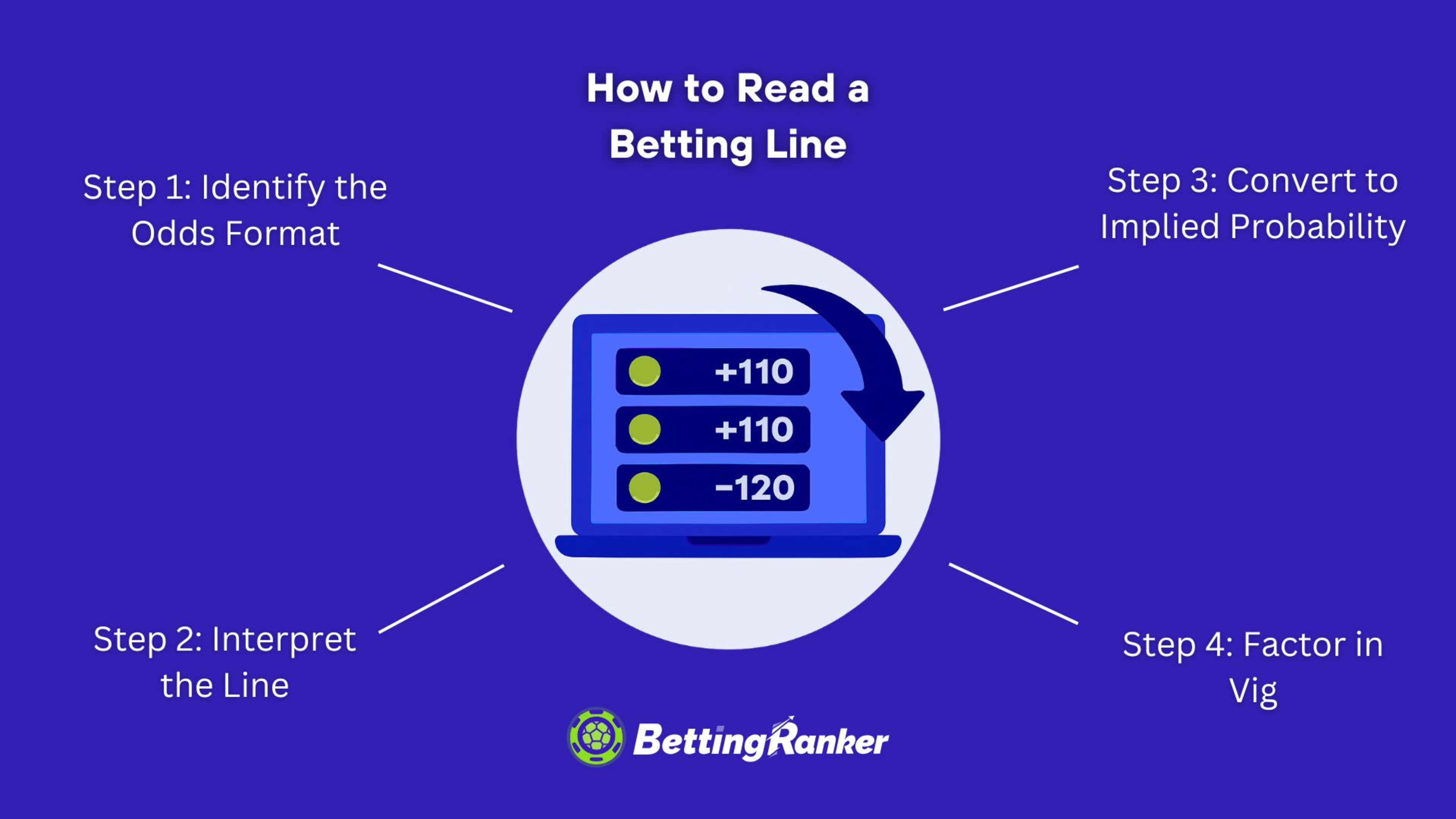
Reading a betting line involves understanding the odds format, the implied probability, and the potential return on your stake. For UK players, this is key to making informed bets.
Step 1: Identify the Odds Format You're Seeing
Online bookmakers in the UK will display odds in American, decimal, or fractional formats. Recognising which system is being used is your first step to understanding the bet.
- Example: An NFL game lists the Eagles at –120 and the Cowboys at +110.
Step 2: Interpret the Line
- –120 (Eagles): You must wager $120 to profit $100.
- +110 (Cowboys): A $100 bet returns $110 profit.
This indicates the Eagles are the favorite, while the Cowboys are the underdog.
Step 3: Convert to Implied Probability
Odds show payouts, but implied probability shows the bookmaker’s assessment of the chance an event happens. Formula:

- –120: 120 / (120 + 100) = 54.5% chance.
- +110: 100 / (100 + 110) = 47.6% chance.
Step 4: Factor in Vig
If probabilities across both sides add up to more than 100%, the difference is the sportsbook’s margin, or vig. In this case: 54.5% + 47.6% = 102.1%, meaning the book built in a 2.1% edge.
Line Movement Explained
Betting lines shift when sportsbooks adjust odds in response to betting volume, sharp action, or external factors such as injuries and weather. Understanding these shifts helps bettors identify and capitalize on value.
Why Lines Move
- Public Money – Recreational bettors often back favorites or popular teams. When large amounts of public money come in on one side, sportsbooks may adjust the line to balance action.
- Sharp Money – Professional bettors (known as sharps) place large wagers based on models or insider info. Books respect this action more heavily and shift lines accordingly.
- External Factors – Injuries, roster announcements, weather conditions, and even coaching news can trigger immediate adjustments.
- Market Perception – A narrative or hype cycle (e.g., a star player streaking) can push odds even without substantial betting volume.
Example Timeline
Consider an NFL game:
- Opening Line: Chiefs –3 vs. Bills.
- Midweek: Heavy sharp money arrives on the Bills, shifting line to Chiefs –2.5.
- Game Day: Weather forecast shows strong winds, lowering total from 48.5 to 45.
Each move reflects new information or risk management.
Why It Matters
Tracking line movement helps bettors identify where money is flowing and whether they should “bet early” to capture favorable odds or “bet late” to wait for overreactions.
For a deeper dive into spotting trends and timing wagers, see our full guide on betting picks, where expert analysis highlights sharp-vs-public dynamics.
The Role of Vig (Juice) in Betting Lines
The vig (also called juice) is the built-in commission a sportsbook charges on every line, ensuring profit regardless of outcome. The vig is why standard point spread odds are often listed as –110 on both sides. If you bet $110 to win $100, that extra $10 represents the bookmaker’s margin.
Example of Vig in Action
Consider an NFL spread where both teams are listed at –110:
- Bet $110 on Team A → profit $100 if they cover.
- Bet $110 on Team B → profit $100 if they cover.
Combined implied probability:
- –110 = 52.38% chance per side.
- 52.38% + 52.38% = 104.76%.
That extra 4.76% above 100% is the vig. It’s the bookmaker’s edge, guaranteeing long-term profitability even if bets are evenly split.
Why Vig Matters to Bettors
- Reduces Expected Value: Vig tilts payouts slightly against bettors.
- Varies Across Sportsbooks: Some books offer –105 lines instead of –110, which significantly reduces the house edge.
- Key in Line Shopping: Understanding vig makes it clear why comparing odds between books is critical.
Bettors who ignore vig underestimate the true cost of betting. Factoring it into every wager is essential for managing bankroll and spotting value opportunities.
Line Shopping & Finding Value
Line shopping — comparing odds across multiple sportsbooks — is one of the simplest and most effective ways to maximize long-term profitability in sports betting.
Why Line Shopping Matters
Small differences in odds can have a big impact over time. For example:
- Book A lists Team X at –110.
- Book B lists the same team at –105.
A bettor wagering $100 saves $5 in risk for the same profit. Over hundreds of bets, this reduces losses and boosts expected value.
Practical Example
An NBA game total is set at 210.5 points:
- Sportsbook A: Over/Under –110.
- Sportsbook B: Over –105, Under –115.
Choosing Over –105 instead of –110 improves your long-term ROI, even though it seems like a small margin.
Tactics for Line Shopping
- Use Multiple Sportsbooks: Register with several regulated operators to compare odds before betting.
- Focus on Vig: A line at –105 instead of –110 means less vig, increasing your edge.
- Check Market Timing: Some lines are softer at open, while others become sharper closer to game time.
- Leverage Comparison Tools: Odds aggregators make it easier to find the best prices in real time.
Line shopping isn’t about chasing every tiny edge — it’s about consistently placing wagers at the most favorable price. Over time, this can be the difference between being a losing bettor and breaking even or even winning.
Advanced Insights — Props, Exotic Lines & Derivatives
Beyond standard moneyline, spread, and totals, sportsbooks post props, exotic lines, and derivative markets that give bettors additional ways to find value.
Prop Bets
Props (short for proposition bets) focus on specific outcomes rather than the overall result. These can be player-based (e.g., “LeBron James Over/Under 25.5 points”) or team-based (e.g., “Which team scores first?”). Props often have softer lines, making them attractive for bettors who specialize in certain matchups. For a deeper breakdown, see our full guide to prop betting.
Exotic Lines
Exotic markets include unusual or event-specific wagers that fall outside traditional categories. Examples include alternate spreads/totals, parlay combinations, or betting on unique events, such as coin tosses in the Super Bowl.
Derivative Markets
Derivative bets are tied to segments of the main game line. For instance:
- First-half totals instead of full-game totals.
- Quarter spreads in basketball.
- Team totals for specific sides.
These allow bettors to isolate edges in game flow without committing to the full outcome.
Advanced betting lines give savvy bettors more options to exploit inefficiencies. However, they require discipline, as sportsbooks often widen the vig on props and exotics compared to standard lines.
Mistakes to Avoid When Betting on Lines
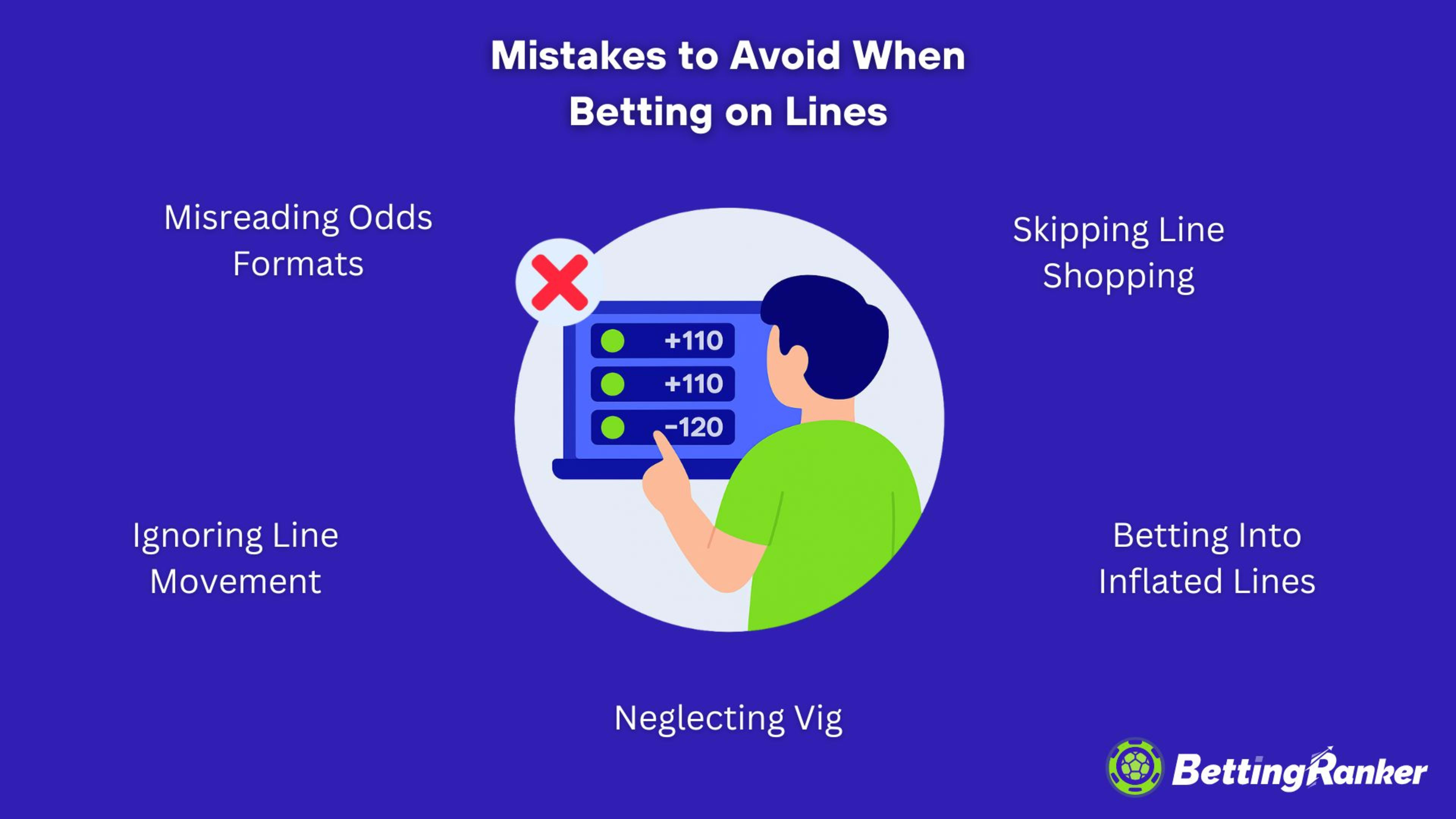
Most bettors lose money on betting lines because they misunderstand odds, ignore movement, or fail to shop for value. Avoiding these mistakes is essential for long-term improvement.
- Misreading Odds Formats. Confusing American, decimal, or fractional odds leads to poor stake calculations and unrealistic expectations.
- Ignoring Line Movement. Betting too early or too late without monitoring shifts can result in taking a worse price than what was available.
- Neglecting Vig. Failing to account for juice means underestimating the true cost of a bet and overvaluing potential returns.
- Betting Into Inflated Lines. Popular teams often attract substantial public funding, which can inflate odds. Chasing them after movement reduces your edge.
- Skipping Line Shopping. Settling for one sportsbook’s price instead of comparing multiple books leaves long-term value on the table.
Conclusion
Betting lines are the backbone of sports wagering. They determine payouts, reflect market sentiment, and reveal the sportsbook’s edge through vig. Mastering how lines work is essential for anyone serious about betting.
By learning how to read odds, track line movement, factor in vig, and shop for the best prices, bettors can transform raw numbers into actionable insights. Advanced markets like props and derivatives expand the opportunities but require even greater discipline.
To continue building your knowledge beyond betting lines, explore BettingRanker’s complete library of betting guides, where you’ll find strategies and resources designed to help you bet smarter and with confidence.
Related News
FAQ
What is a betting line in sports?
A betting line represents the odds and market conditions a bookmaker offers for a specific wager. It indicates the potential winnings relative to your stake and reflects the bookie's assessment of an outcome's probability. Betting lines can include money lines, point spreads, totals (over/under), proposition bets (props), or derivative bets.
Why do betting lines move?
Lines shift as bookmakers respond to betting volume, informed (sharp) betting activity, or new information. For instance, if a key player sustains an injury, the line might change significantly to account for the team's diminished prospects. Substantial public betting on a popular favourite can also influence a line, even if the underlying probabilities remain unchanged.
What is the difference between odds and lines?
Odds are the numerical representation of potential payouts (e.g., 1/1, 5/4, 10/11). A line is the specific market offered – such as a money line on a team to win or a point spread of -2.5. In essence, odds are the price, while lines define the bet's structure.
What does –110 mean in betting?
While -110 is more common in American betting, a similar concept exists in fractional or decimal odds. It essentially represents the bookmaker's margin. For example, odds of 10/11 imply you need to stake £11 to win £10 profit. This "extra" amount is the bookmaker's commission (the vig), ensuring the house maintains profitability over time.
How does vig affect betting lines?
The vig (or commission) reduces your long-term expected value by subtly decreasing payouts. For instance, if both sides of a point spread are priced at 10/11, the implied probabilities total more than 100%. This excess represents the bookmaker's edge. Opting for bookmakers with reduced-vig lines (e.g., offering slightly better odds) can significantly improve your return on investment (ROI).
How can I find the best betting line in the UK?
The most effective strategy is line shopping – comparing odds across various UK bookmakers before placing your bet. Even minor differences, such as 5/6 versus 10/11, accumulate into substantial savings over numerous bets. Utilising odds comparison websites and opening accounts with several reputable bookmakers ensures you consistently secure the most favourable price. Always gamble responsibly.
Do betting lines guarantee accuracy?
No. Lines are designed to balance sportsbook exposure, not to predict exact outcomes with certainty. They are influenced by probabilities, but also by public opinion and betting volume. Astute bettors use lines as indicators, but always consider contextual factors such as injuries, current form, and head-to-head records. Remember to gamble responsibly.